Tyler Hobbs’ practice is deeply focused on the exploration of what separates human and machine creativity, and what will result from the inevitable coalescence of the two. His work asks whether algorithmic logic can reflect and build upon the analogue messiness of organic gesture, integrating two otherwise distinct creative systems. Generative Art, as a methodology, is a reliance on a system, but that does not mean it is the prerogative of a machine only: analysis of generative drawings reveals that there are underlying patterns and structures to even the "human flaws” in these works.
Hobbs’ practice is not an attempt to replace the artist’s hand but to extend it through the algorithm, to see whether code, as a medium, can inherit the emotional and gestural charge once reserved for the brush. Where early computer artists sought to formalise aesthetic rules, Hobbs reintroduces intuition, randomness, and imperfection into the system. In doing so, he reframes the algorithm not as a neutral executor of logic but as a living substrate for expression, a space in which the human impulse toward gesture persists.
While artists such as Vera Molnár, Frieder Nake, and Harold Cohen pioneered the use of computers as creative collaborators in the 1960s and 70s, their computational work was often not fully understood within the wider art world, confined to laboratories and academic circles rather than mainstream galleries and fairs. Hobbs continues his experimental explorations but operates within a cultural moment where the coexistence of man and machine is inevitably embedded in the quotidian. The visibility of his work in venues such as Art Basel marks a shift in how technological collaboration is understood: not as a threat to authorship but as a valid means of intensifying expression.
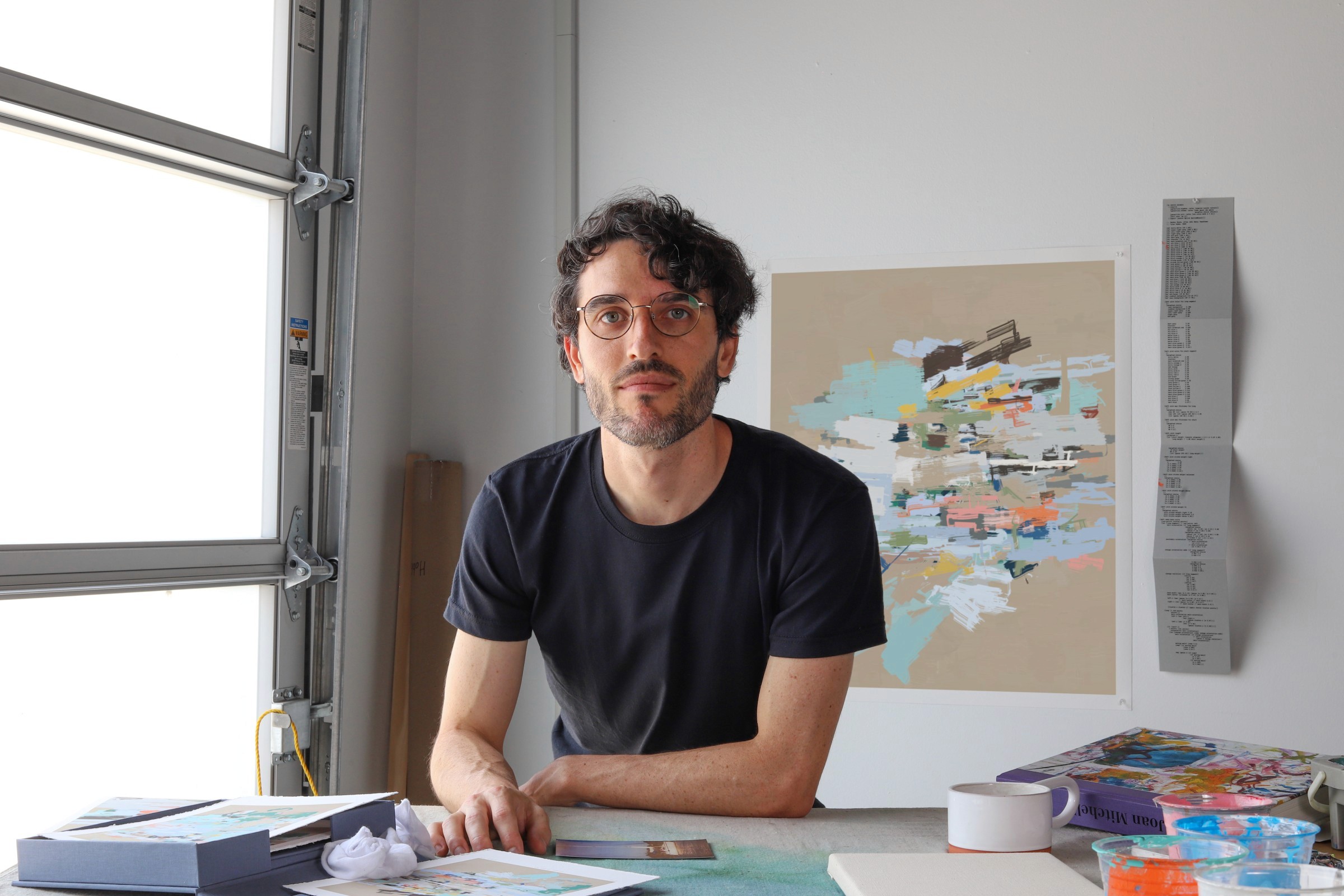
Hobbs’ work bridges two histories: that of generative art’s procedural rigor, and that of painting’s search for vitality through mark and motion, inspired by the likes of Cy Twombly and Joan Mitchell. Hobbs’ new body of work, From Noise, is less a break from either tradition than a convergence, a continuation of the centuries-old question of how order and chaos, control and freedom, can coexist within a single creative act.
In From Noise, Hobbs deepens this exploration through a sustained dialogue with his algorithm. The thirteen works emerge not from a single act of execution but from a recursive process of creation, iteration, and curation. Here the algorithm itself becomes an evolving collaborator: responding, adapting, and accumulating traces of Hobbs’ aesthetic decisions. Each piece contains more than 4,000 individual marks, forming a dense choreography of motion that reads as both computational and painterly. The works form a maximalist counterpoint to the quieter spirit of his earlier Day Gardens series, illustrating what he calls the “pendulum effect,” a natural swing between minimal restraint and overflowing complexity that defines his evolving practice.
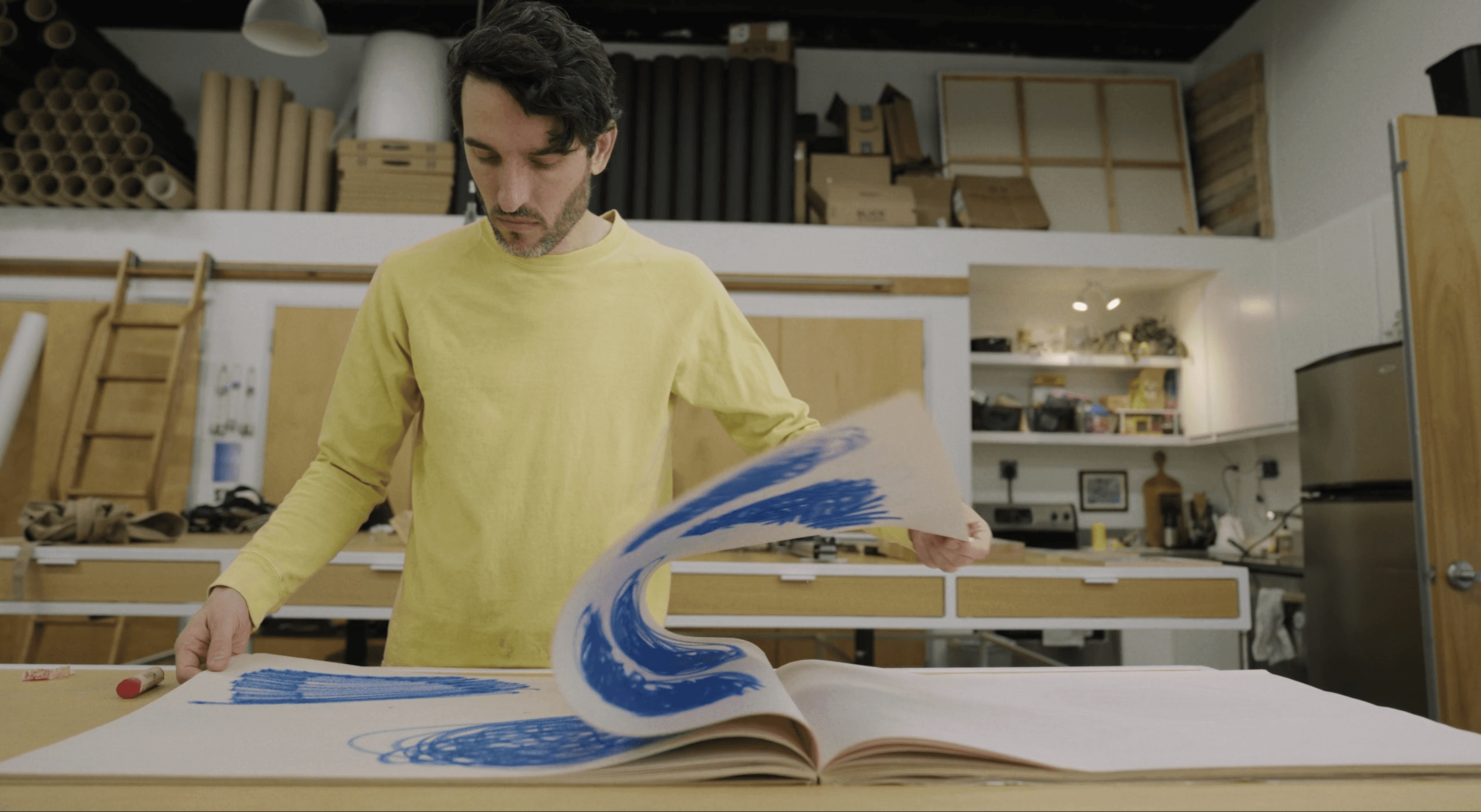
Hobbs translates these digital generative works into physical pieces to further emphasise their materiality and warm, printing them on wood panels with layered surfaces that recall the depth and texture of traditional painting. Through this physical translation, the digital mark gains body and weight, bridging the immaterial logic of code with the tactile immediacy of pigment and woodgrain.
At its core, From Noise captures a moment in the evolution of Hobbs’ code: an ever-shifting system that, like any artist’s hand, refines itself through repetition, error, and intuition. Each work becomes both document and dialogue, a snapshot of the middle ground where emotion, gesture, and computation briefly align before diverging again into new possibilities.